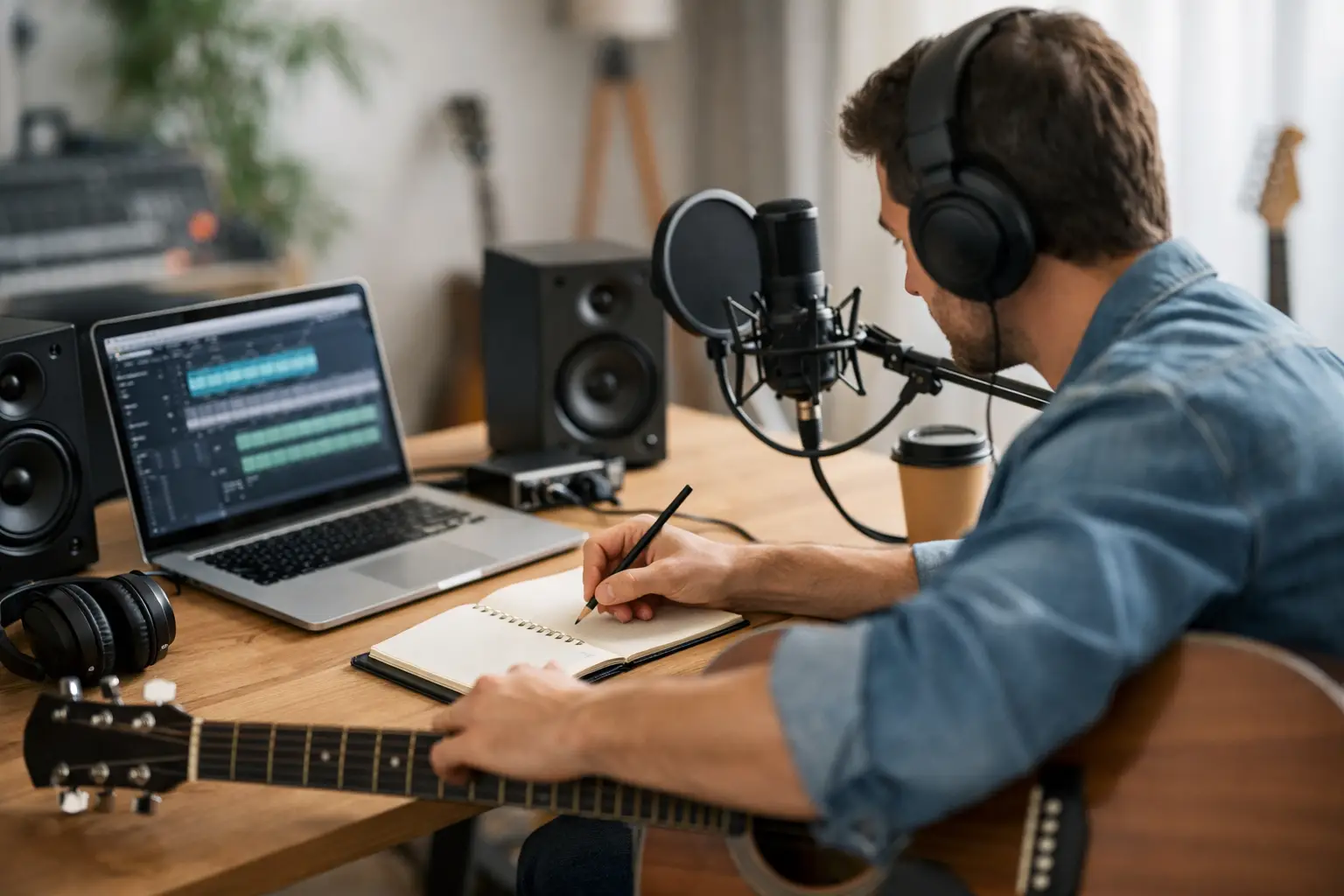
Most people asking how to start an independent music career are really asking a harsher question: how do you make work that feels like yours, put it online, and keep going when nobody owes you attention?
That’s the real start. Not a logo. Not a distributor. Not a fake rollout copied from artists with teams and budget. If you want an independent music career, you need a body of work, a point of view, and enough stamina to repeat yourself without becoming repetitive.
How to start an independent music career without copying one
The first move is not branding. It’s definition. What do you actually make, and what do you refuse to make?
A lot of new artists stay vague because they think flexibility helps. Usually it just makes them forgettable. Independent artists get remembered when the work has edges. Maybe you make fragile ambient tracks with blown-out drums. Maybe your songs sit between post-punk, noise, and bedroom pop. Maybe your music is minimal, but your visual world is dense. Fine. Say that. Build from there.
You do not need a neat genre label, but you do need a recognizable center. If people hear one track, see one image, and land on one profile, they should feel the same mind behind all of it.
That part matters more than people admit. Listeners don’t just follow songs. They follow artistic gravity.
Start with songs, not strategy decks
If you have three unfinished ideas and a folder full of inspiration screenshots, you are still in private mode. To start a career, you need released work.
That does not mean waiting until you have a perfect album. It means finishing enough material to prove your direction is real. For some artists, that’s two strong singles. For others, it’s a short EP. The format matters less than the standard. Put out the work that sounds like a beginning, not a random upload.
There’s a trade-off here. Releasing too early can freeze weak material into your public identity. Waiting forever does the opposite – it keeps you invisible. A better rule is simple: release when the music is clear, not when it is flawless.
If your production skills are limited, use the limitation on purpose. Raw is fine. Flat is not. Lo-fi is a choice if the feeling survives. If the song only works because you keep explaining the idea behind it, it probably needs more work.
Build a small world around the music
Independent careers rarely grow from audio alone. People discover music through fragments – a clip, an image, a sentence, a live video, a strange thumbnail, a comment that sounds like a person instead of a campaign.
So build a world your music can live inside.
That world can be minimal. It can be a simple site, consistent cover art, one strong photo set, and active profiles where your work is easy to find. It can also include static visual art, rough process clips, or short performance edits if that fits your practice. What matters is coherence. Your pages should not feel like separate personalities run by separate people.
This is where a lot of artists overdo it. They make assets before they make identity. Start smaller. Pick fonts you can live with. Pick colors that don’t fight the music. Pick one visual logic and repeat it until it becomes yours.
If you work across mediums, use that. Experimental artists often have an advantage here because the audience is not looking for polished genre packaging. They’re looking for a signal that the artist has an actual interior life.
How to start an independent music career online
Online growth is not random, but it is uneven. One post can do nothing. Another can bring in your first real listeners. That does not mean you should turn your project into content sludge.
Use platforms as distribution for attention, not as the center of your identity.
For most independent artists, that means posting in ways that are sustainable. Short clips of unreleased work. Visual edits built from your own material. Snippets of process. Performance fragments. Direct statements about what you’re making. Not every post needs a strategy. But every post should feel like it came from the same artist.
Instagram and YouTube still matter because they let people see and hear your work quickly. If someone finds you there, they should be able to understand three things fast: what you sound like, what you look like, and where to hear more.
Consistency matters, but not in the fake productivity sense. You do not need daily output. You need repeated presence. A dead page makes people assume the project is dead. A living page, even a quiet one, tells them to pay attention.
Make discovery easy
A surprising amount of talented music stays buried because the artist makes discovery annoying.
Your artist name should be easy to search. Your music should be available on the main streaming platforms if streaming matters to you. Your bio should be short and specific. Your profiles should point to the same project, not five half-abandoned versions of it.
If you have a website, keep it clean. Give people music, visuals, a short identity statement, and obvious paths to your active channels. That’s enough.
Metadata matters too, even if it’s boring. Correct titles, credits, release dates, and artwork all help create legitimacy. Independent does not mean careless. The more experimental your work is, the more useful clean presentation becomes. It gives people something stable to hold onto while the art does stranger things.
Audience first is bad advice if it kills the work
A lot of career advice tells artists to study demand first and build for the market. That can help if your goal is functional pop content. It can kill an independent voice fast.
You still need audience awareness. You should know who responds to your work, where they spend time, and what kind of framing gets them to click. But if you build entirely around consumption habits, the project starts sounding pre-compromised.
A better approach is this: make the strongest version of your actual work, then learn how to frame it so the right people can find it.
That is slower than trend-chasing. It is also more durable.
Independent careers are usually built by depth, not by broad appeal. A hundred real listeners who return, share, and care are more useful than a spike of passive traffic from people who never come back.
Money comes later, but not infinitely later
You do not need a giant audience to start earning. But you do need to stop thinking of income as betrayal.
There are a few natural ways independent artists make money: streaming, direct sales, commissions, merch, visual art, live shows, production work, licensing, and supporter-based models. Which path fits depends on your work. If your audience is niche but invested, direct support often matters more than scale. If your songs are cinematic, sync opportunities may fit better. If your visual identity is strong, prints or objects might connect more naturally than shirts with your name on them.
The point is not to monetize everything immediately. The point is to notice what your practice already makes possible.
What you should avoid is building expenses that require fame to justify them. Expensive videos, constant ad spend, and outsourced branding can trap new artists in a version of professionalism that looks serious but produces nothing. Keep your overhead low. Spend where it improves the art or makes access easier.
Collaboration helps, if it sharpens you
Doing everything alone is romantic until it starts weakening the work.
Independent does not mean isolated. It means you choose your dependencies. Work with people who increase precision, not noise. That might be a mixing engineer who understands texture. A videographer who can translate your visual instincts. Another artist who challenges your habits.
Bad collaboration blurs identity. Good collaboration makes it more visible.
If you’re early, your network may be small. That’s fine. Build sideways. Trade skills. Show up for artists you actually respect. Internet scenes still matter, even when they look fragmented. A lot of sustainable careers come from repeated proximity, not one lucky breakthrough.
Stay long enough to become undeniable
The hardest part of learning how to start an independent music career is accepting that the beginning is rarely dramatic. It often looks small, repetitive, and slightly embarrassing from the inside.
You release something. A few people notice. You release again. Your visuals get clearer. Your songs get sharper. Your audience gets more specific. After a while, the project stops looking hypothetical.
That’s the shift.
You do not need to act bigger than you are. You need to become more legible, more committed, and more exact over time. The artists who last are not always the loudest. Usually they are the ones who keep refining the signal until the right people can hear it clearly.
Start with the work. Keep the identity intact. Make it easy to find you. Then keep going long enough for the pattern to hold.